All about the genuine Sabah Claim Society

ATTENTION! This blog is the genuine Sabah Claim Society.

We are Philippine patriots who have grouped together from around the world and who created the Sabah Claim Society group originally on Facebook on 15 July 2011 and counted close to 6,000 members.

But on 5 October 2011 our group on Facebook was traitorously hijacked by two people we had invited to join us as group admins but who, we learned later on, had been hired to sabotage our patriotic group by a group of sinister individuals sporting fake European sounding nobility titles and other spurious Tausug/Sulu titles ['bestowed' and indiscriminately distributed on Facebook] and organized by a combined team of charlatans namely a datu (sporting a fake sultan title) and the latter's handler who is conveniently sporting an absolutely fake 'princely' title as well.

Please be warned that the said group of individuals, we believe, are in fact con artists out to "claim" Sabah for "get rich quick" reasons and are not genuine Philippine patriots. Their motive, we have discovered, is to be able to convince Malaysians that they are genuine Sulu royalty and pro-Philippine Sabah claim supporters in order to extract from Malaysia (which has control of Sabah today) a premium for letting go of the Sabah claim.

For more information on the Philippine Sabah claim, please join the ongoing discussions by clicking on the following link on Facebook: Philippine Sabah Claim Forum

Pages

Showing posts with label South China Sea. Show all posts

Tuesday, 1 April 2014

US accuses China of provoking Philippines

US accuses China of provoking Philippines

Washington (AFP) - The United States criticized China as provocative Monday after its coast guard tried to block a Philippine vessel that was rotating troops in the tense South China Sea.
The attempted Chinese blockade, which led to a two-hour standoff with the Philippine ship, is "a provocative and destabilizing action," State Department deputy spokeswoman Marie Harf told reporters.
Harf said that the Philippines had permission to resupply troops to the remote reef, the Second Thomas Shoal, because it has kept a naval presence there since before a 2002 declaration of conduct in the South China Sea.
"As a treaty ally of the Republic of the Philippines, the United States urges China to refrain from further provocative behavior by allowing the Philippines to continue to maintain its presence at Second Thomas Shoal," she said.
The incident was the latest in the South China Sea, where China claims a vast area that overlaps with several neighbors' claims.
On March 9, China successfully turned away a similar resupply boat from the Philippines.
The United States has been warning China against taking more drastic action in the South China Sea after it declared an air defense identification zone in November over much of the East China Sea, including islands administered by Japan.

http://news.yahoo.com/us-accuses-china-provoking-philippines-215239395.html

Thursday, 13 February 2014

US would honour its mutual defence treaty with the Philippines

Manila (AFP) - The United States will "help" the Philippines in the event that China occupies disputed islands in the South China Sea, the US Chief of Naval Operations said Thursday.
Admiral Jonathan Greenert also stressed that the US would honour its mutual defence treaty with the Philippines amid a seething territorial conflict with China over the resource-rich waters.
http://news.yahoo.com/us-39-help-39-philippines-south-china-sea-153118749.html


Thursday, 21 November 2013

The Taiwan Straits Crisis – A Hair’s Breadth from Annihilation


The Taiwan Straits Crisis – A Hair’s Breadth from Annihilation

Sixty years have come and gone, but the sun has yet to set on the Taiwan Straits Crisis. Stranded on the rocky island of secrecy amid the storms of the Cold War (1947-1991), the mists of time should not be permitted to veil the lessons that must be learned.  In the U.S. during the early 1950s, Eisenhower was in office, China was engaged in a civil war, the Soviets were antsy, and the Air Force longed to hear the words  ‘the pickle is hot’ indicating they were free to unload armaments. The only thing missing from the high-tension plot was a bevy of brilliant beauties unless, of course, you consider Madam Chiang Kai-shek and Hedy Lamar.
Like a fine dining experience, the Taiwan Straits crisis unfolds in courses paired with the appropriate drink. In the late 1920s, China engaged in a great civil war. Following the final gasp of the Qing Dynasty in 1917, China was an unwieldy briar patch. From the political vacuum of swirling cultures and societal chaos coupled with the sheer size of the country, two primary competing forces emerged; Mao Tse-tung who would be at the helm of the Peoples’ Republic of China (PRC) with a Communist agenda and Chiang Kai-Shek (ROC) who would lead the forces that did not want communism.

Friday, 27 September 2013

Manila's UN challenge vs China over disputed waters gathers pace behind 'formidable' legal team

Manila's UN challenge vs China over disputed waters gathers pace behind 'formidable' legal team

HONG KONG - The Philippines' legal challenge against China's claims in the South China Sea is gathering pace, emerging as a "proxy battle" over Beijing's territorial reach.
Manila has assembled a crack international legal team to fight its unprecedented arbitration case under the United Nations' Convention on the Law of the Sea - ignoring growing pressure from Beijing to scrap the action.
Any result will be unenforceable, legal experts say, but will carry considerable moral and political weight.
The Philippines has invested a "huge amount of political capital in this legal gambit and it wants to ensure success regardless of the cost," said security scholar Ian Storey of Singapore's Institute of South East Asian Studies.
"If the Philippine team submits a less than convincing case...this would be very embarrassing for Manila and put it right back to square one in its dispute with China.
"Beijing would also be emboldened to pursue its claims even more assertively than it has been doing over the past few years."
Beyond the legal questions, the case carries political and diplomatic risks and is being closely watched by Japan and Vietnam, locked in their own disputes with China over sea territory, officials from both countries say.
The United States, which is deepening military ties with the Philippines, a longstanding treaty ally, is also watching.
The legal battle mirrors tensions at sea, where China and the Philippines eye each other over rival occupations of the Scarborough and Second Thomas shoals.
Chinese vessels occupied Scarborough after a tense two-month standoff between rival vessels last year - a move some regional analysts have described as an effective annexation by Beijing.
The Philippines accused China of further encroachment when a naval frigate and two other ships steamed within five nautical miles of a dilapidated transport ship that Manila ran aground on Second Thomas Shoal in 1999 to mark its territory.
One Asian envoy from a non-claimant country said: "We are watching and worrying about an accident or miscalculation sparking an armed confrontation. So in some ways this growing legal fight looks like the proxy battle, you could say."
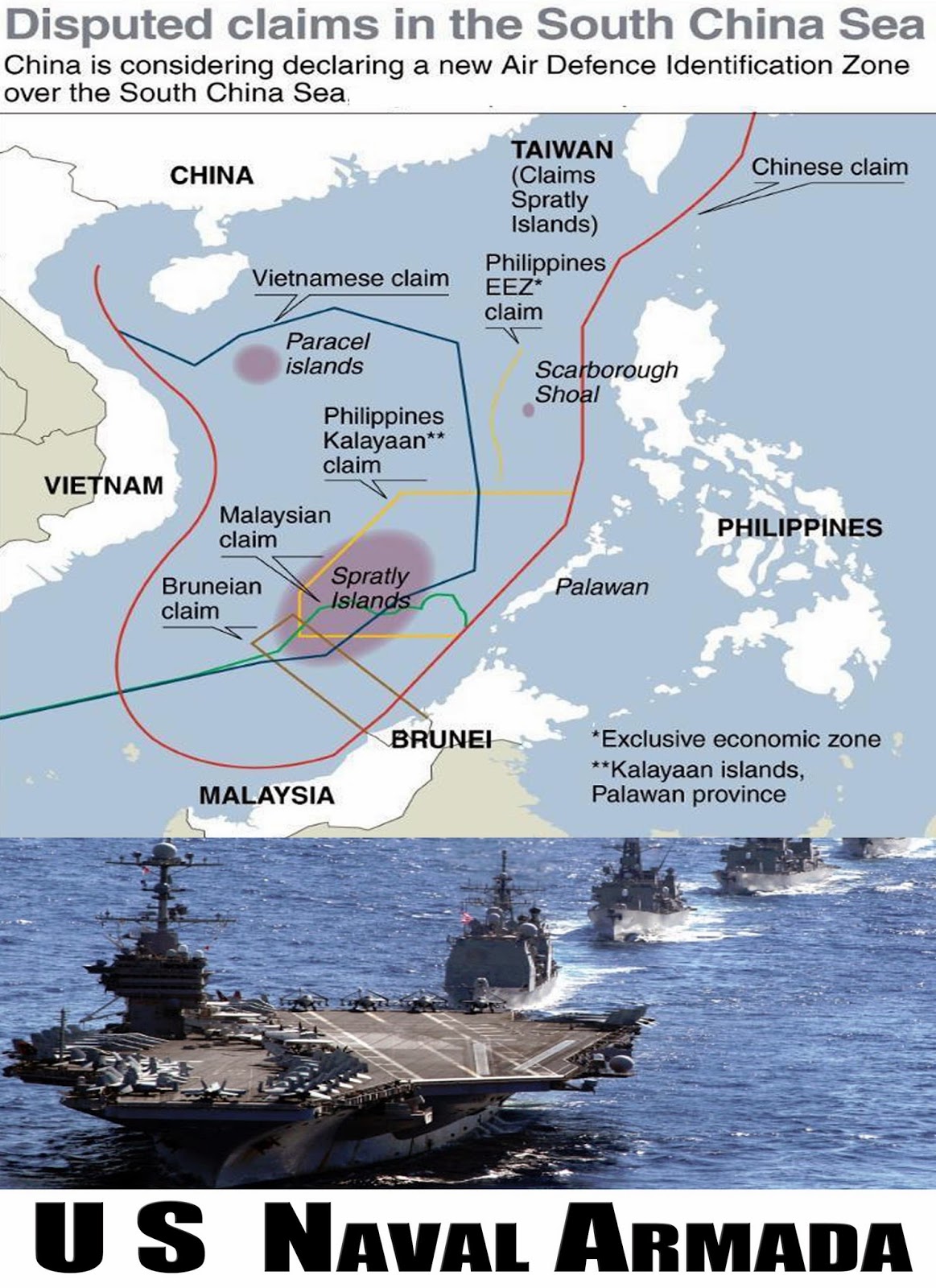
Overlapping claims in the South China Sea - traversed by half the world's shipping tonnage - are one of the region's biggest flashpoints amid China's military build-up and the U.S. strategic "pivot" back to Asia.
The claims of the Philippines, Vietnam, Malaysia and Brunei are bisected by China's "nine-dash line" - the historic claim that reaches deep into the maritime heart of Southeast Asia.
European states, Russia, India and South Korea are also monitoring events, given the sea's shipping lanes and potential oil and gas resources, diplomats and military officials say.
http://www.interaksyon.com/article/71686/manilas-un-challenge-vs-china-over-disputed-waters-gathers-pace-behind-formidable-legal-team

Tuesday, 23 July 2013

China arms unified coast guard agency to handle sea conflict

 China arms unified coast guard agency to handle sea conflict

China is bent on showing the international community that it has indisputable jurisdiction over the waters over which China claims ownership.
China is now arming a united coast guard agency to prove its jurisdiction over the disputed waters.
China’s new unified coast guard agency has gone into operation, state media reported Tuesday amid maritime disputes with neighbors, and experts said more ships will be armed as a result.
The China Coast Guard integrates the functions of marine surveillance, the existing coast guard which came under the police, fisheries law enforcement and Customs’ anti-smuggling maritime police.
The divisions “that were not allowed to be equipped with weapons can be armed now,” Yang Mian, professor of international relations at the Communication University of China, was quoted as saying by the Global Times newspaper.
“The new agency will also make our law enforcement more powerful.” The new agency will “have reasonable and legal law enforcement equipment” and “detect and rapidly handle in accordance with the law acts that harm China’s maritime rights and interests”, Zhang Junshe, a military researcher, wrote in a commentary in the PLA Daily.
Tensions have been growing over China’s island disputes with Japan and other neighbors.
Chinese surveillance ships have frequently approached disputed islands in the East China Sea, which Japan controls and knows as the Senkakus but which China claims as the Diaoyus, after Tokyo nationalized some of them last September.
The Philippines and Vietnam have accused Beijing of aggressively asserting its extensive claims in the South China Sea, although tensions have abated slightly with Hanoi in recent weeks.
With an eye on the rows, the United States has strengthened military cooperation with Japan and the Philippines — which are both treaty-bound allies — as well as with former war adversary Vietnam.

Tuesday, 16 July 2013

UN tribunal starts arbitration process on PHL-China sea dispute


UN tribunal starts arbitration process on PHL-China sea dispute

July 16, 2013 4:50pm

A United Nations tribunal has been convened in the Netherlands to look into a complaint filed by the Philippines questioning the legality of China’s massive territorial claim in the resource-rich South China Sea.

“The Philippine government is pleased that the Arbitral Tribunal is now formally constituted, and that the arbitration process has begun,” Foreign Affairs spokesman Raul Hernandez told a press briefing Tuesday.
   
The progress in the Philippines’s legal challenge against China comes amid increasing animosity between the two Asian neighbors due to their long-standing territorial conflict.

Manila and Beijing recently traded diplomatic barbs over the Philippines’s decision to seek international arbitration - the latest manifestation of a longstanding territorial feud between the two countries over South China Sea territories.

Recently, the conflict was reignited with tense confrontations between Chinese and Philippine vessels in two disputed shoals – Scarborough and Ayungin – off Manila’s western coasts.

At their first meeting on July 11, the President and Members of the Tribunal designated The Hague in the Netherlands as the seat of the arbitration and the Permanent Court of Arbitration as the Registry for the proceedings, the Department of Foreign Affairs (DFA) said.

Part of the process is to determine if the tribunal has jurisdiction over Manila’s complaint. The case will only proceed once the tribunal decides that the complaint filed by the Philippines has legal merit and falls under its jurisdiction.

“Whether they have decided jurisdiction, they will publicly announce this,” Hernandez said.

Manila pledged its “fullest cooperation” with the tribunal “in order to assure a fair, impartial and efficient process that produces a final and binding judgment in conformity with international law.”

Manila, Washington widen talks for military deal

Manila, Washington widen talks for military deal

MANILA (Reuters) - Washington and Manila have expanded talks on military cooperation to include possible U.S. funding to build facilities and the storage of U.S. humanitarian relief supplies, the Philippine envoy to the United States said on Tuesday.
The wider scope of the talks for joint use of civilian and military facilities signals rapidly warming security ties between the allies as the Philippines looks to the U.S. administration to help counter a newly assertive China.
The Philippines has ruled out granting permanent basing rights to Washington, Ambassador Jose Cuisia said, but it would give U.S. warplanes and warships wider access to Philippine bases on a temporary and rotational basis, helping the Asian nation improve its minimum defence capability.
The increasing rotational presence of U.S. forces in the country is covered by the 1998 Visiting Forces Agreement, but a new arrangement would be needed if Washington built facilities to support its temporary deployment to the Philippines.
"We need to expand (the 1998 pact) further because we may have to build some additional facilities," Cuisia told reporters in the Philippine capital.
The two countries have been in talks since 2011 for "joint use" of civilian and military facilities in the former U.S. colony.
http://news.yahoo.com/manila-washington-widen-talks-military-deal-082344483.html